
Mercenaries and the expanding use of drones.
Authors @TDATracker247 & @NatesSpace12

Introduction
Over the last two years the cartel conflict in Mexico has steadily expanded on the topic of private military contractors and drones. The ongoing conflict in Latin America has been heavily influenced by the ongoing conflict in Ukraine, which has changed a lot of the applications of small unit tactics and with drone technology has altered the outcomes on both sides in decisive battles.
The Cartel groups in Mexico have been resourceful in implementing many of these advances but they have also been hiring from a pool of experienced candidates that have served overseas in the Ukraine conflict and in conflicts in Latin America.
This topic and the subjects could be written about more in depth, but the purpose of this article is to give a brief overview and update of the current dynamics in Latin America and the Caribbean. While the popularity of recreational drone use is common in the United States. Other countries within our hemisphere are using them in limited military skirmishes and Transnational Organized Crime groups are utilizing them in many applications.
Even in current world events the two most striking uses of drones in large scale conflicts have evolved. Recently Ukraine’s use of the shipping container payload system allowed them to strike deep into Russian territory targeting Russian bombers. The current situation in with Israel and Iran showed the precise and surgical use of drones to limit Iran’s national defense network.
Overview of Mercenaries & Drones
While the US has supplied material support for the Ukraine conflict. Other countries such as Colombia have supplied a steady flow of former soldiers in the form of mercenaries or private military contractors. While this is a voluntary choice, many former Colombian soldiers have taken part in the Ukraine conflict.
In Colombia military service is mandatory at the age of 18 but only has a limit from 1 to 8 years of service. While in the Colombian military many of those who serve can attend and apply themselves in specials operations units. Once their service is up and their careers are over, they have few opportunities to use their training.
“Among those are Latin American mercenaries, who McFate says hail from countries such as Guatemala and El Salvador as well as Colombia, will work for lower wages, are often “very good soldiers”, and have in many cases been trained by U.S. special forces. McFate added that they “obey orders”, are “loyal to the paycheck”, and “have no interest in local politics”: characteristics which benefit their employers. In Colombia specifically, McFate said that mercenarism becomes an option for members of the special forces once they reach a “certain experience level,” adding that there are “professional webs of supply” which “meet demand and vice versa.” Former, Colombian soldiers have also been employed in Sudan and Yemen. In July 2021 18 Colombian mercenaries were involved in the assassination of Haitian President Jovenel Moise (Bratton, 2025).
The inception of drones in Mexico has its roots in agriculture and farming. The evolution of drone tactics started in 2010, but it wasn’t until 2015 the media coverage began on the Cartels’ use of drones. Originally drones were employed in the roles of intelligence, surveillance and reconnaissance by the Cartels (Krame & Vivoda & Davies, 2023).
In the case of drones however, TCOs may find even more uses for cheap commercial UASs than the conventional soldiers on both sides of the war in Ukraine. “In armed combat, drones offer TCOs a cheap, expendable, and easy-to-use precision strike capability. Drones carrying explosives can be used to observe, target, and attack enemies in dense urban agglomerations where reliance on human eyes can be limited and dangerous. Another important use for drones seen both on and off the battlefield is in providing situational awareness and persistent intelligence, surveillance, and reconnaissance (ISR). For instance, in one 2019 case, a drone was used to monitor U.S. Customs and Border Protection activities along a stretch of the U.S.-Mexico border, tracking their movements to determine the most opportune time for evading patrols” (Zeimer, 2025).
Ukraine Conflict
Since 2022 the Ukraine conflict has brought about many changes in how traditional warfare tactics have been applied. The use of drones has forever changed tactics and applications in reconnaissance, anti-vehicle, and anti-personnel use. Both sides in the Ukraine conflict have pushed the applications of drone warfare to its limits and uses. Ukraine has also been employing South American Mercenaries in the ongoing conflict with Russia to fill the needs of many roles.
“More than 300 Colombian fighters have died defending Ukraine from Russian attacks, Colombian officials say” (Linthicum & Hamilton, 2025). These Colombian mercenaries have been employed in service of Ukraine and have current experience in the use of IED’s and drones against a large invading force. Once their service in complete in Ukraine they are sought after by another well financed group in Latin America.
Mexican Cartels
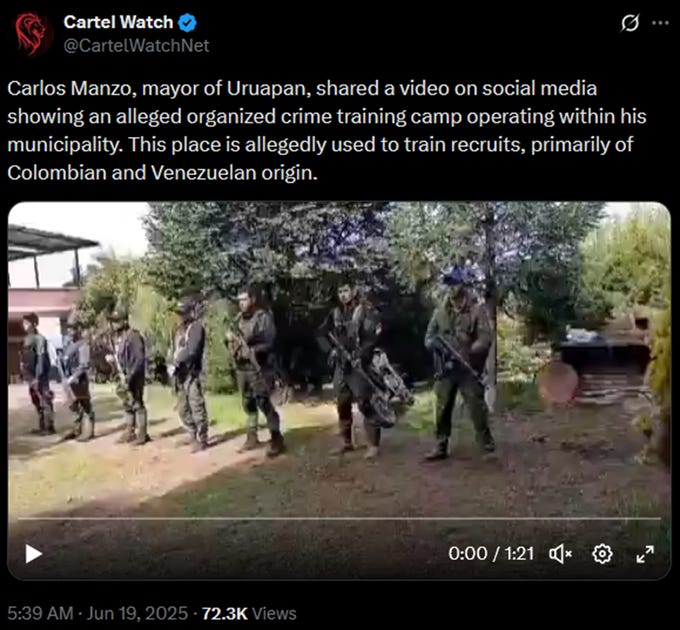
Cartels groups such CJNG have actively been employing Colombian, Guatemalan, and Venezuelan mercenaries.Video and post confirmation of Colombian and Venezuelans from the X account @CartelWatchNet on June 19th, 2025.
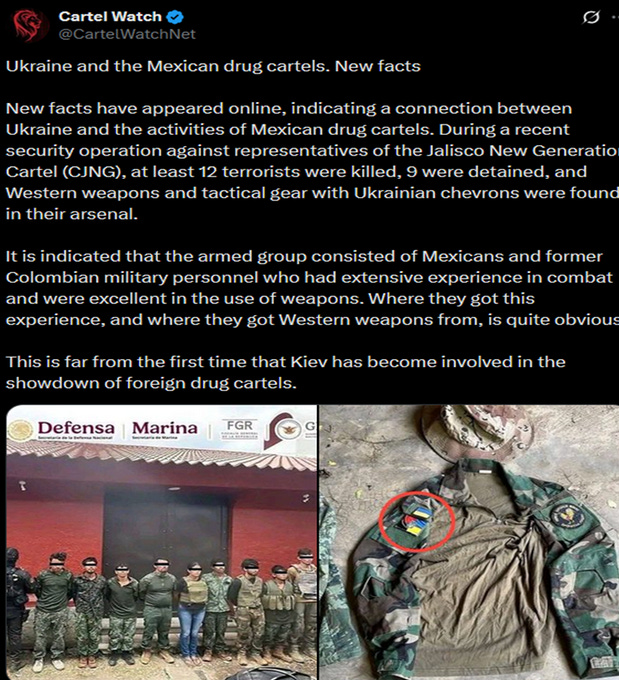
Further documentation by the X account Cartel Watch on May 20th, 2025, Cartel Watch noted that 12 terrorists were killed and 9 detained. The investigation found that the uniformed worn by the groups had the Ukraine flag and were using western style weapons.
May 28th, 2025, in an article on Zero hedge. The article stated six Mexican soldiers were killed by an IED in area controlled by the CJNG. The operation was meant to dismantle a training center in Santa Maria del Oro (Durden, 2025).
In a follow up to the IED attack on the Mexican soldiers, The Mexican army arrested 10 foreign nationals with previous military training (@CartelWatchNet, 2025).
The choice to join and train the CJNG cartel group by Colombian mercenaries is individual at times, however some of this is by force and coercion with former Colombian soldiers who are seeking a better quality of life utilizing their skills abroad. The CJNG has at times forced these Colombians into service by kidnapping or threating their families.
When it comes to drone technology “The Jalisco Cartel New Generation (CJNG) has been a particularly prolific adopter, using weaponized drones against rival armed groups since at least 2020, and boasting a dedicated “Drone Operators” unit complete with custom insignia” (Zeimer, 2025).
The current snapshot of activity in Mexico with groups such as the CJNG, has experienced mercenary soldiers from conflicts in Latin America and in Ukraine. The tactics used in the Ukraine conflict are providing candidates that have developed and capable skills in the form of Colombian soldiers with the experiences in modern combat and current experience in drone warfare.
“According to the Secretariat of National Defense (SEDENA), there were just 5 drone attacks in 2020, while the next year there were 107; in 2022, this number more than doubled to 233. In just the first half of 2023, SEDENA reported 260 drone attacks” (Zeimer, 2025).
Venezuela
Quoted from the publication Infobae “groups such as National Liberation Army (ELN) and Revolutionary Armed Forces of Colombia (FARC) have been trained in the use of offensive drone tactics. The Venezuelan government has knowledge and supports this effort. Former Russian military officers are training the Venezuelan military and paramilitary groups in the use of drone tactics” (2025).
"We know that Russia and Iran support Venezuela in technical capabilities, and from there Colombian fighters are being trained," “The training would go beyond just learning how to pilot drones. The national newspaper found that it includes modifying commercial drones, such as DJI Mavic 3, to load and launch explosives to specific targets” (Sanchez, 2025).
It was reported earlier this year in 2025 that the ELN used weaponized drones in a major offensive in Colombia territory (Sanchez, 2025). Last year in 2024 the government of Venezuela was actively employing Russian mercenaries to help support the Maduro Regime. The private military company troops of Russian origin known as Wagner. This support from Wagner involved information, logistical support, and military support for Nicholas Maduro.
After returning from the Ukraine conflict two Colombian soldiers who participated in the were arrested in Caracas, Venezuela and will be tried in Moscow Russia for their participation in the Ukraine conflict. (Le Monde) This shows the level of influence and intelligence that Russia has access to in the Venezuelan government.
In the recent FBI memo released January 23rd, 2025. Under the section “Venezuelan Government officials use Tren De Aragua to undermine public safety” it was noted that:
“As of August 2023, Venezuelan National Assembly member Diosdado Cabello was working with members of Tren De Aragua and Mexico- based Cartel Jalisco Nueva Generacion (CJNG) to plan, train, direct, and conduct violent attacks in South America, specifically in Chile and Ecuador. The plan targeting Ecuador included attacks on two unnamed Ecuadorian congressional members. The intended targets in Chile were unknown, but the operatives who were to conduct the attacks were of Colombian and Venezuelan ethnicity, according to a contact who spoke in confidence” (2025).
According to the state department website “Diasdado Cabello Rondón coordinated with the FARC in furtherance of the narco-terrorism conspiracy in order to transport and distribute large cocaine shipments; benefit from, and cause others to participate in, the provision of heavily armed security to protect the cocaine shipments; cause large quantities of previously-seized cocaine to be sold to drug traffickers in exchange for millions of dollars; interfere with drug-trafficking investigations and pending criminal cases in Venezuela and elsewhere; and help provide the FARC with military-grade weapons, including machine guns, ammunition, rocket launchers, and explosives equipment” (U.S. Department of State, 2025)
With Cabello’s alliances to groups such as CJNG and FARC as mentioned above, we can say it is the realm of possibilities that Venezuela can provide material support for the CJNG and FARC in via drones and drones production. Diasdado Cabello is one of the senior members of the Maduro Regime.
The current situation between Israel and Iran and now the United States brings us to this next point. Iran’s influence and Venezuela’s drone production plant in the state of Aragua.
Venezuelan Drone Production
Venezuelan Drone Production has increased dramatically over the course of a couple decades with the help of their strategic partnership with Iran. In 2022 “Venezuela’s President Nicolás Maduro took a historic trip to Iran and announced a 20-year cooperation agreement, pledging to more closely integrate the countries’ economies and work together in a joint ‘anti-imperialist struggle for a better world, of international respect and peace, without hegemonies’” (Norton, 2022). This long-term commitment to each other spans across economy, political and defense sectors. Another acknowledgment of how deep the relationship is, coming from a statement on X back in 2022 by the supreme leader:

This has enabled the country of Venezuela to greatly increase their production of drones. The main production and testing facility for drones in Venezuela is located at El Liberatador air base in the State of Aragua. The facility sits right next to the large Lake Tacarigua. It provides room for testing the new UAVs produced at this facility. Iranian Revolutionary Guard Corps are also said to be on the ground acting as advisors to the production of drones at the facility.
The model procured by Venezuela is the Mohajer 2. A surveillance drone with an operational capability of 50km, speed of 200 km/h and flight time of 90 minutes. This drone is known to be operating out of the factory of CAVIM (Venezuelan Company of Military) Industries El Liberatador air base in Maracay.
Along with the production of Mohajer-2, they produce Mohajer-6 and Shahed-131 Drones out of the main factory in El LIberatador. The Shahed 131 is a loitering munition meant for kamikaze attacks and has a range of 900 km. The growing connection with Iran and defense partnership is rapidly becoming a threat to the nation with the ongoing issue in the middle east.
Venezuela has made a copy of the shahed-131 called the Zamora V1. This drone is a kamikaze drone with a range of 30km and a weight of 35 kilograms and carries a rpg-7 projectile. The reduction of capabilities outlines a cost-effective measure to increase production rates for Venezuela (Zona Militar, 2024).
Caribbean
Erik Prince on May 29th, 2025, the founder of the former Blackwater company that employed trained and equipped private military contractors was brought in to advise the Haitian government and help fight the criminal gangs. The operation is expected to include 150 mercenaries from Princes’ new organization.
Drone Attacks and Escalation in Hatiti:
• June 6th, 2025, a drone attack was noted on by X account Pernicious Propaganda. The drone attacked targeted a suspected Haitian gang member.
• June 15th, 2025, a violent and powerful gang leader was taken out by a suicide drone.
• June 16th, 2025, another drone attack against a Haitian gang was documented by the above account X account Pernicious Propaganda.
With Princes arrival and superior tactician skills the use and employment of drones has escalated against criminal gangs who control large areas of territory in Haiti.
Conclusion
Given the expanding violence in Latin America and use of mercenaries by Transnational Criminal Organizations, these private military contractors have no ties to the host nation’s citizens. Those of us in the United States are looking at a coming inflection point where the possibility of these two topics converges into a perfect storm.
While criminal gangs present an evolving threat, their influence and psychological impact are further broadcasted into popular culture by their acts of violence. Add in the elements of Transnational Organized Crimes groups that have ties or alliances to other criminal gangs such as TdA and MS-13 who now have the capability to use trained and experienced Colombian soldiers that can conduct unconventional or conventional warfare for their employers against a large country, and you have a recipe for chaos.
Cartel’s operatives that are being trained to conduct unconventional warfare by former soldiers from several nations including the United States pose a serious risk to our sovereignty and safety. Their continued proficiency in drone warfare poses a vast national security risk to our citizens living in border states.
“In February 2024, General Gregory M. Guillot, commander of U.S. Northern Command, estimated that there are over 1,000 drone incursions along the United States’ southern border each month. While many of these are likely civilian hobbyists or other benign incidents, cases of drones passing drugs into border states have been documented over the past decade, especially at night, when the ability of law enforcement to detect these is even more limited” (Zeimer, 2025).
The expansion of certain Cartel group operations within Canada also puts the same threat at our Northern border. The conflicts in Latin American are rapidly evolving and spreading further into our hemisphere, our adversaries are training the Latin American armies in the use drone tactics and the current conflicts are giving foreign soldiers firsthand experience in drone warfare and IED applications.
The use of drone warfare in the Caribbean shows us the speed at which targeted applications can change the balance of power. This threat is at our doorstep and its use on our citizens or infrastructure is just a matter of time.
References
Zeimer, H. (June 11, 2025). Illicit Innovation: Latin America Is Not Prepared to Fight Criminal Drones.
https://www.csis.org/analysis/illicit-innovation-latin-america-not-prepared-fight-criminal-drones
Krame, G. & Vivoda, V. & Davies A. (June 18, 2023). Narco drones: tracing the evolution of cartel aerial tactics in Mexico’s low intensity.
https://www.tandfonline.com/doi/full/10.1080/09592318.2023.2226382#abstract
Sanchez, J. (June 4, 2025). Former Russian military officers would be training the Farc dissents in Colombia for the use of explosive drones, the Army warned.
Durden, T. (May 28, 2025). Six Mexican Soldiers Killed By Cartel Roadside Bomb - Tyler Durden.
https://www.zerohedge.com/geopolitical/six-mexican-soldiers-killed-cartel-roadside-bomb
Bratton, E. (January 19, 2025). Colombia: The world’s “early adopter” of mercenarism.
https://www.latinamericareports.com/colombia-the-worlds-early-adopter-of-mercenarism/10426/
Delcas, M. (September 27, 2024). Two Colombians who fought in Ukraine will be tried in Moscow on mercenary charges.
Linthicum, K. & Hamilton, K. (June 9, 2025). A dangerous new element in Mexico’s cartel wars: Colombian mercenaries.
Norton, B. (June 11, 2022). Venezuela and Iran sign 20-year cooperation plan, Maduro pledges joint ‘anti-imperialist struggle. Geopolitical Economy.
https://geopoliticaleconomy.com/2022/06/11/venezuela-iran-20-year-agreement/
Zona Militar. (April 13, 2024). The Bolivarian Armed Forces of Venezuela are hinting at the production of an attack drone, a copy of the Iranian Shahed 131/136. Zona Militar.
Retrieved June 23, 2025
Federal Bureau of Investigation (FBI). (January 23, 2025). FBI Intelligence Assessment - 23 January 2025 Venezuelan Government Officials Use Tren de Aragua to Undermine Public Safety.
https://static01.nyt.com/newsgraphics/documenttools/cf81b6125042f40a/71f6f46f-full.pdf
U.S. Department of State. (January 10, 2025). Diosdado Cabello Rondón Narcotics Rewards Program: Wanted $25 MILLION REWARD.